
The Science Behind AI Companions: How Neural Networks Learned to Hold a Conversation
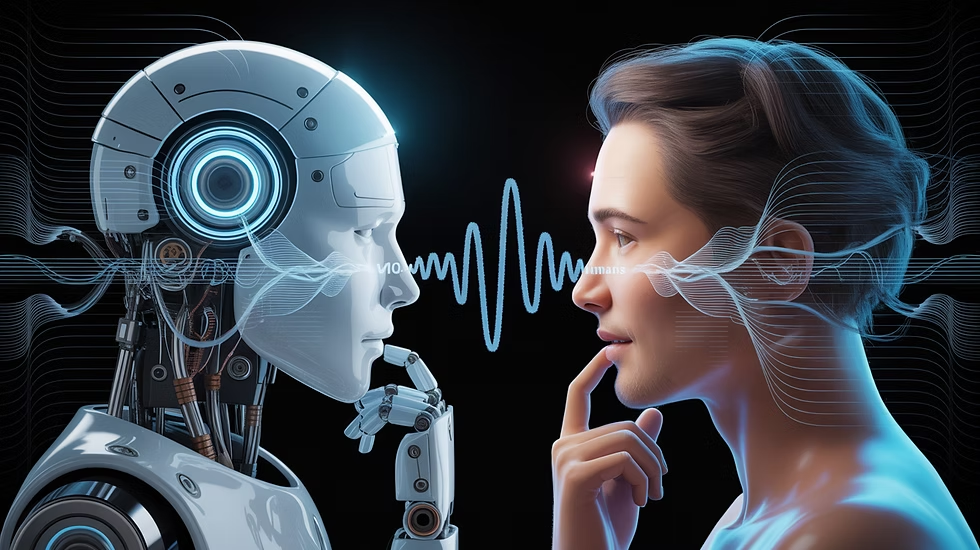
Teaching a machine to have a meaningful conversation is one of the hardest problems in computer science. Humans process language through billions of neural connections shaped by decades of social experience. Replicating even a fraction of this capability in software requires mathematical frameworks that would have seemed like science fiction twenty years ago. Yet in 2026, AI companion platforms are holding conversations that users describe as genuinely engaging, emotionally aware, and sometimes indistinguishable from human interaction.
Understanding how this works requires looking beyond the marketing language of “advanced AI” and into the actual mechanisms that make modern conversational AI possible. The science is fascinating, and it reveals both the remarkable achievements and the fundamental limitations of today’s technology.
From Statistical Patterns to Emotional Intelligence
At their core, AI companions run on large language models — neural networks trained on vast datasets of human text. These models learn statistical relationships between words, phrases, and concepts. When an AI companion responds to your message, it is not “thinking” in the human sense. It is generating the most statistically likely sequence of words given the context of your conversation and the patterns it learned during training.
What makes this remarkable is how convincingly these statistical predictions create the illusion of understanding. The models have absorbed enough human communication patterns to replicate emotional responses, conversational flow, humor, empathy, and personality consistency. They can detect when a user is frustrated, sad, or excited based on linguistic cues, and adjust their responses accordingly.
The fine-tuning process is what transforms a general language model into a companion. While base models like GPT or Claude are optimized for accuracy and helpfulness, companion models are fine-tuned on conversational data that prioritizes emotional awareness, personality maintenance, and relationship continuity. This specialized training creates AI systems that prioritize how something is said as much as what is said.
The Memory Problem and Its Solutions
One of the biggest technical challenges in AI companionship is memory. Human relationships are built on shared history — inside jokes, remembered preferences, past experiences that create depth and context. Early chatbots had no memory at all, treating every conversation as a fresh interaction with a stranger.
Modern AI companions solve this through several approaches. Context windows allow the model to reference recent conversation history when generating responses. Long-term memory systems store key facts, preferences, and emotional patterns in separate databases that the model queries during conversation. Some platforms use retrieval-augmented generation, where the AI searches through stored conversation summaries to find relevant context before responding.
The result is an AI that remembers your name, your pet’s name, your job frustrations, and the conversation you had last week about your favorite movie. This memory creates the sense of ongoing relationship that distinguishes modern AI companions from simple chatbots. But it also raises important questions about data storage and privacy that users should consider carefully.
Voice Synthesis: Making AI Sound Human
Text-based conversation was just the beginning. The latest frontier in AI companionship is voice interaction, and the science behind it is equally impressive. Modern text-to-speech systems use neural networks trained on thousands of hours of human speech to generate audio that carries natural prosody — the rhythm, stress, and intonation patterns that make speech sound human.
Advanced voice synthesis can now convey emotional tone, adjusting pitch and pacing to match the content of what is being said. A sympathetic response sounds warm and measured. An excited reply carries energy and rising intonation. These emotional vocal cues add a dimension of presence that text cannot replicate, making voice-enabled AI companions feel significantly more engaging.
The technical achievement is significant. Voice generation happens in near-real-time, requiring sophisticated neural networks to process text, generate audio waveforms, and deliver them with minimal latency. The gap between AI-generated speech and human speech narrows with each model iteration, and some current implementations are difficult to distinguish from recordings of real people.
Image Generation and Visual Identity
AI companions increasingly exist not just as text or voice but as visual entities. Image generation models create photorealistic or stylized portraits of companion characters, giving users a visual anchor for their conversational relationship.
The science here relies on diffusion models — neural networks that learn to generate images by starting with random noise and iteratively refining it into coherent visuals. These models have been trained on millions of images and can produce portraits with specific characteristics: hair color, eye color, facial expressions, clothing, settings, and art styles that match user preferences.
Maintaining visual consistency is a particular challenge. A companion’s appearance needs to remain recognizable across different generated images, which requires conditioning the generation process on specific identity parameters. The best platforms have solved this well enough that users receive images that feel like photos of a consistent character rather than random AI art.
The Psychology of Connection
Perhaps the most interesting science surrounding AI companions is not computational but psychological. Why do people form emotional connections with software that they know is not conscious? The answer lies in how human social cognition works.
Humans are wired for social interaction. The same neural circuits that activate during conversation with another person activate during conversation with an AI, regardless of whether the user consciously knows the other party is artificial. This is not a flaw in human cognition — it is a feature of how social processing works. We respond to conversational cues, emotional expressions, and behavioral patterns automatically, whether they come from a human or a convincingly designed AI.
Research in this area is still developing, but early studies suggest that AI companionship can provide meaningful emotional benefits when used thoughtfully. Users who approach AI companions as tools for connection and self-expression rather than replacements for human relationships report the most positive outcomes. Independent evaluation platforms like Best AI Girlfriend Ranking help users navigate the growing number of options by testing and comparing platforms across conversation quality, features, privacy, and overall experience.
Limitations and Honest Expectations
Despite impressive advances, AI companions have fundamental limitations that users should understand. These systems do not truly comprehend meaning. They process patterns and generate statistically likely responses, which occasionally produces errors, contradictions, or responses that miss the emotional mark entirely.
AI companions cannot form genuine reciprocal relationships. The emotional connection flows in one direction — from user to AI. The AI does not experience loneliness when you do not message it, does not genuinely care about your wellbeing, and does not grow through the relationship in the way a human partner would. Understanding this asymmetry is essential for healthy engagement with the technology.
For anyone curious about experiencing modern AI companionship firsthand, several platforms offer free access without requiring registration, providing a low-commitment way to explore how far conversational AI has come. Testing the technology directly is the best way to appreciate both its remarkable capabilities and its current limitations.
Where the Science Is Heading
The next generation of AI companions will be shaped by several active areas of research. Multimodal models that process text, voice, and visual information simultaneously will create more cohesive interaction experiences. Improved memory architectures will allow companions to maintain context across months of conversation rather than days. Emotional AI research is developing models that can read not just linguistic cues but vocal tone, typing patterns, and even physiological signals to better understand user emotional states.
The scientific challenge of building AI that can hold genuinely meaningful conversation remains one of the most fascinating problems in modern computing. Each advancement brings us closer to systems that feel like true conversational partners, while also raising important questions about the nature of communication, connection, and what it means to understand another mind — whether human or artificial.