
Business Expansion in the EU: How Foreign Entrepreneurs Can Set Up a Company in Poland
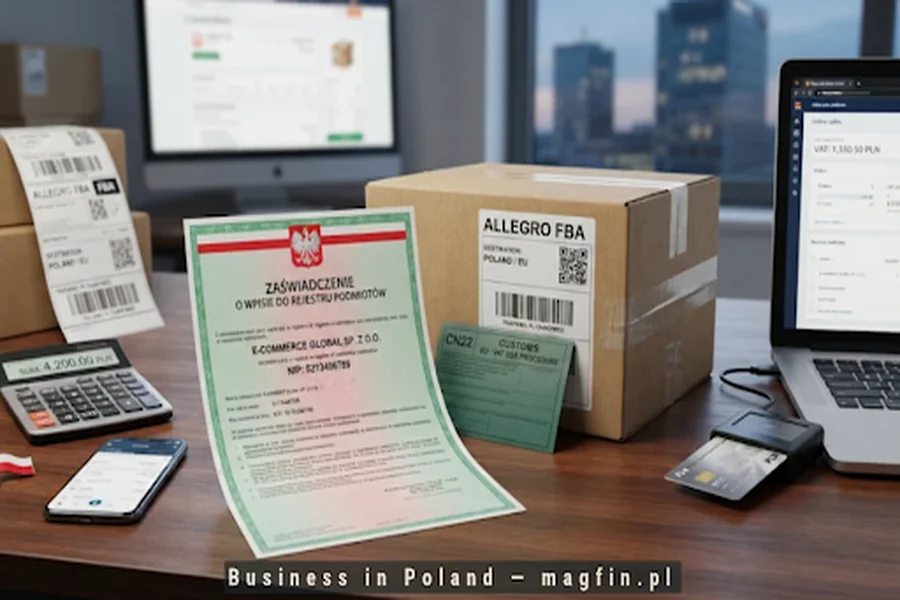
Entering the European Union market is a logical step for companies looking to expand sales, reach customers with greater purchasing power and access the EU single market. Poland is a particularly practical choice. It offers a large domestic market, well-developed logistics, clear basic rules for foreign entrepreneurs and a convenient starting point for selling in other EU countries.
However, opening a business and launching an online store or starting marketplace sales in a new jurisdiction requires careful planning. Initial problems are rarely caused by the business idea itself. They are more often linked to choosing the wrong legal structure, misunderstanding tax thresholds, applying VAT rules incorrectly to cross-border transactions or overlooking requirements for product listings and returns.
Getting Started: Choosing a Business Structure and Registering a Company in Poland
Foreign entrepreneurs planning to conduct full-scale business operations in Poland, hire employees and sign contracts with local warehouses, courier companies or payment providers often choose a limited liability company, known in Poland as a Spółka z ograniczoną odpowiedzialnością (Sp. z o.o.).
Why Sp. z o.o. Is a Popular Choice for E-commerce
- Shareholders are generally liable for the company’s obligations only up to their contributions, rather than with their personal assets.
- Foreigners can establish and manage a Polish company. Shares can also be transferred or sold, and new business partners can join.
- A Polish legal entity can make it easier to access payment processing services, local payment gateways, logistics operators and B2B suppliers.
- Unlike simplified business structures available to certain residents, a Sp. z o.o. must maintain full accounting records. This system can accommodate business growth and higher transaction volumes.
Main Steps in Setting Up a Company
- A company can be registered remotely through the S24 system using standard articles of association and an eligible electronic signature, such as Profil Zaufany or a qualified eIDAS signature. Alternatively, the founders can sign individual articles of association before a notary and submit the application to the National Court Register (KRS). For e-commerce businesses with complex ownership arrangements or specific shareholder exit conditions, individually drafted articles may be more suitable than a standard template.
- After registration, the company receives its KRS number, NIP (tax identification number) and REGON (statistical identification number).
- Active VAT registration (czynny podatnik VAT) is generally important from the beginning, particularly for businesses purchasing goods within the EU or using special VAT procedures. The exact registration requirements depend on the business model and transactions.
- A corporate bank account is necessary for supplier payments, taxes and other business expenses. Polish online stores should offer familiar payment methods, including BLIK, instant bank transfers through Przelewy24, PayU or Tpay, payment cards and instalment or deferred payment options.
- Accounting is an essential part of running a Sp. z o.o. The company must comply with regular reporting obligations involving VAT, JPK, payroll and corporate income tax.
E-commerce Business Models: How to Sell to Polish Customers
A successful online store in Poland requires both legal compliance and a shopping experience that meets local expectations. Polish consumers are familiar with online shopping and pay close attention to prices, delivery times and return policies.
Choosing Sales Channels
- This gives the company full control over its brand, profit margins, customer database and SEO strategy. However, it requires investment in development, localisation, security and traffic acquisition.
- These platforms provide access to an established customer base and allow businesses to test demand quickly. However, sellers must account for platform commissions, strict service performance requirements and price competition.
- Businesses can start selling through marketplaces to test their product range while developing their own online store for key product categories and repeat purchases.
Localisation and Online Trading Requirements
- The website, product descriptions, order confirmation emails, delivery information and customer support should be available in accurate Polish. Poor machine translations and ambiguous wording can undermine customer trust.
- Polish consumer protection rules require clear information before a purchase. Customers must be able to see the total price, including applicable taxes, delivery costs, estimated delivery times, ordering procedures and cancellation conditions.
- Consumers generally have 14 calendar days to withdraw from a distance contract without giving a reason. Certain statutory exceptions apply, including personalised goods and specific hygiene-related products once unsealed.
- Polish customers expect convenient home delivery and parcel locker services, including Paczkomaty and similar networks. A straightforward domestic return process is also important. Customers should not have to deal with complicated international shipping arrangements.
How VAT OSS Works and Why It Matters for EU Sales
When an online store starts selling goods to individual consumers (B2C) in other EU countries, the seller must determine which country’s VAT rate applies and where the tax should be reported and paid. The VAT One Stop Shop (OSS) scheme was introduced to simplify cross-border B2C sales within the European Union.
Understanding the VAT OSS Scheme
Instead of registering for VAT separately in every EU country where customers receive their orders, an eligible business can register for OSS in one EU member state, such as Poland.
The scheme allows the business to:
- Charge VAT at the rate applicable in the customer’s destination country.
- Submit a single quarterly VAT OSS return through the tax administration portal in its country of registration.
- Make one consolidated VAT payment covering relevant EU countries. The tax administration then distributes the amounts to the respective member states.
The VAT Threshold and Key Rules
- Businesses established in only one EU member state, without relevant establishments in other member states, may apply the common EUR 10,000 threshold to qualifying cross-border sales of goods and certain digital services. The threshold covers the current and previous calendar years. While the threshold is not exceeded, domestic VAT rules generally apply, provided all relevant conditions are met. Once the threshold is exceeded, VAT is normally due at the rate applicable in the customer’s country. VAT OSS simplifies the reporting process. Businesses can also opt into OSS voluntarily, subject to the applicable conditions.
- Sales to customers in Poland from a Polish warehouse are reported through standard Polish VAT returns, not VAT OSS. The OSS scheme applies to qualifying cross-border B2C distance sales from one EU country to consumers in other EU countries.
- The scheme simplifies VAT reporting and payments for qualifying distance sales. However, it does not eliminate the need for local VAT registration when a business stores its goods in another EU country. This can happen when using marketplace fulfilment programmes or third-party logistics centres. Moving a company’s own goods between EU countries and storing them abroad creates additional VAT reporting obligations.
Conclusion
Opening a business in Poland gives foreign entrepreneurs access to the EU single market and opportunities to expand e-commerce across Europe. Choosing the right company structure, understanding VAT obligations and using the VAT OSS scheme correctly are essential for avoiding tax mistakes and building a sustainable business: magfin.pl